
Chris Arnold, HIS
|
|
2min read
When you begin researching solutions for your hearing health, it’s natural to evaluate the delivery model of the care you receive.
You may find yourself wondering why hearing aids in Canada must be dispensed through a licensed professional rather than being available for direct purchase, as they are in the US.
It is easy to assume that a clinic simply acts as a point of sale, ordering a device from a manufacturer and passing it along to you with a markup. You deserve absolute clarity regarding what you are paying for and why this professional model exists.
In Canada, hearing aids are regulated medical devices. By law, they cannot be sold directly to consumers without the involvement of a registered clinician.
But this structure is not a hurdle designed to complicate your purchase; it is a protective framework established to ensure your safety and the efficacy of your treatment.
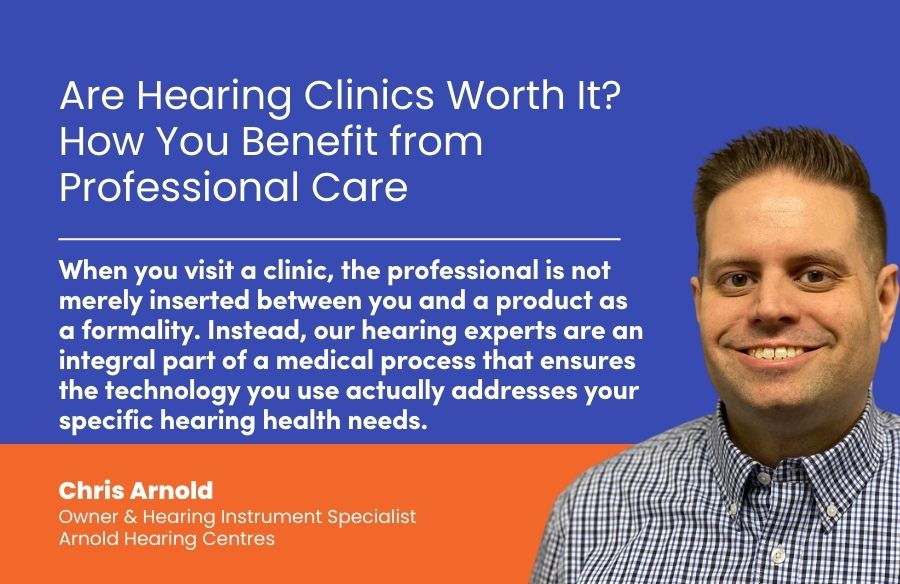
When you visit a clinic, the professional is not merely inserted between you and a product as a formality. Instead, our hearing experts are an integral part of a medical process that ensures the technology you use actually addresses your specific hearing health needs.
A Hearing Aid Is Not the Treatment, It’s the Tool
You benefit most when you view hearing healthcare as a clinical intervention rather than the purchase of a high-tech gadget.
While the hearing aid itself is a marvel of engineering, the true treatment is the application of audiological expertise to your unique auditory profile.
When you engage with our professional clinic, you benefit from diagnostic testing that goes far beyond a simple "pass or fail" screening. Your hearing health professional maps your hearing across a wide range of frequencies, assesses your speech clarity in quiet and noisy environments, and evaluates your brain’s ability to process auditory information. This data forms a medical prescription.
Your treatment plan is based on medical-grade assessment equipment and calibrated sound environments, not on self-reported guesses or automated algorithms. Without this professional evaluation, a hearing aid cannot be accurately programmed to your needs.
You might be surprised to learn that two individuals with identical audiograms (the graph showing their hearing loss) will still require different programming. This is because every ear canal has a unique shape, size, and resonance that changes how sound behaves once it enters your ear.
A device without prescription-level customization is simply amplified sound; it increases volume without necessarily restoring clarity.
You deserve the precision that only a comprehensive hearing assessment can provide.
Hearing Happens in the Brain, Not Just the Ear
Hearing rehabilitation involves much more than your ears; it requires your brain to relearn how to process sound.
If you have lived with hearing loss for several years, your auditory cortex may have "forgotten" how to interpret certain frequencies. Simply turning on a hearing aid at full strength can be overwhelming and ineffective.
You benefit from gradual programming adjustments during a structured acclimatization period.
You can rely on our team to manage this transition by slowly increasing the prescription levels as your brain adapts. Expect ongoing fine-tuning sessions where your hearing health professional adjusts the device based on your real-world experiences.
Early hurdles such as sound fatigue, difficulty due to increased cognitive load, and challenges with speech clarity are normal parts of the journey. A clinic provides the structured support and neurological guidance you need to navigate these challenges successfully.
You’re not just scheduling an appointment but gaining a partner who understands the biological complexity of communication, ensuring you do not give up on your hearing health prematurely.
Ongoing Care: Where the Real Value Lives
Over time, your hearing levels may change and your lifestyle needs may evolve, much like how eyesight can change as we get older. This is why the relationship with your clinic does not end at the initial fitting. Hearing care is a continuous process rather than a one-time transaction.
You benefit from annual reassessments to ensure your devices are still meeting your needs, as well as professional cleanings and maintenance to extend the life of your technology and maintain peak performance.
If your devices require repair, you can rely on us to coordinate manufacturer service and provide temporary loaner solutions so your life is not put on hold. By choosing a clinical setting, you ensure that your investment is protected by a long-term partnership.
Why Regulation Exists in Canada
Hearing loss can sometimes be a symptom of an underlying medical issue, such as an ear infection, a perforated eardrum, or even a growth on the auditory nerve.
You benefit from a safeguard that identifies these issues early. Conditions such as sudden-onset hearing loss, significant asymmetry between ears, or conductive hearing components require medical referral pathways that a retail-only model simply cannot provide.
With mandated professional involvement, you can feel confident that you’ll receive safe amplification levels and medical oversight. This is about your protection, ensuring that the "solution" you seek does not inadvertently mask a condition that requires a physician's attention.
The Clinic Is the Bridge, Not the Barrier
Ultimately, a hearing clinic does not sit between you and a product as a barrier; it serves a bridge for the gap between complex technology and your unique biology.
To get started on your hearing health journey with our professional team, don’t hesitate to get in touch. You deserve a long-term partner who is committed to your communication health and your ability to stay connected to the people you love!
Frequently Asked Questions (FAQ)
Q: Why can’t I just buy a hearing aid online and program it myself if I have my test results?
A: A hearing aid is a complex computer that must account for your ear canal's physical acoustics. Even with your test results, you lack the equipment required to verify that the sound reaching your eardrum is safe and accurate.
Without this verification, you risk "over-masking" or causing acoustic trauma to your ears. Furthermore, professional software is often restricted to licensed clinicians to ensure the medical integrity of the device settings.
Q: Is the cost of the hearing aid mostly for the plastic and electronics?
A: When you purchase hearing devices, you are investing in the clinician’s diagnostic expertise, the specialized medical equipment used to test and verify the devices, and several years of follow-up care, adjustments, and cleanings.
You can rest assured that a significant portion of your investment is allocated to the professional services that ensure the device actually works for your brain and your lifestyle over the long term.
Q: What happens if my hearing changes in two years? Do I have to buy new devices?
A: One of the primary benefits of working with a clinic is that your devices are adjustable; if your hearing fluctuates or declines, you benefit from an updated assessment where your clinician can recalibrate your existing hearing aids to match your new prescription.
This flexibility is a core part of the clinical model; the goal is to keep your current technology relevant and effective for as long as the hardware allows, typically five to seven years.
Source
Canadian Academy of Audiology: Read more about Canada’s stance on over-the-counter hearing aid dispensing here.

Chris Arnold
Owner & Hearing Instrument Specialist
Growing up in Kitchener, Ontario, Chris went to Durham and George Brown College. As the owner of Arnold Hearing Centres, he manages all locations, as well as handles all the marketing, reporting, meetings, and makes sure that both the staff and patients have a positive experience.


Search
